
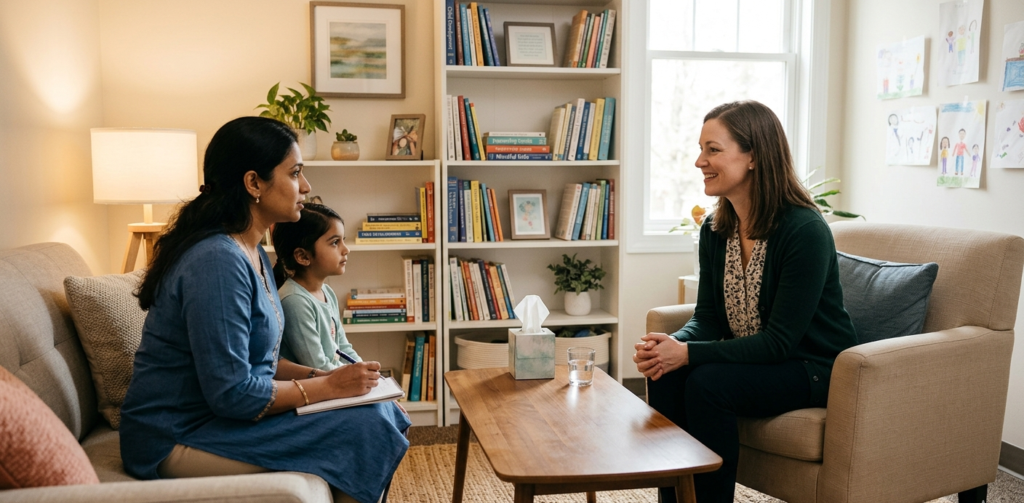
Parenting is one of the most meaningful roles a person can hold – and one of the hardest to navigate alone. Whether your child is going through a difficult stretch, you have questions about what is happening in their therapy sessions, or you simply want to be a more confident and intentional parent, a parent consultation offers a dedicated space to get the support and clarity you need.
But what exactly is a parent consultation, how is it different from other types of therapy, and how do you know if it is the right step for your family? This article answers all of those questions.
What is a parent consultation?
A parent consultation is a one-on-one session held between a therapist and a parent or caregiver – separate from any sessions the child may be attending. It is not therapy for the parent in the traditional sense. Instead, it is a focused, collaborative meeting designed to help caregivers better understand their child’s emotional and behavioral needs, explore effective parenting approaches, and feel more prepared and confident in their role at home.
Think of it as having a knowledgeable, non-judgmental professional in your corner – someone who can help you make sense of what you are observing at home, give language to your concerns, and work alongside you to figure out what your child might need most right now.
| This service focuses on collaboration, reflection, and problem solving – helping parents feel more confident and supported in their role. |
Parent consultations are especially valuable for caregivers of tweens and teens, where the emotional landscape can shift quickly and the usual parenting playbook does not always seem to apply anymore.
Who is a parent consultation for?
You do not need to be in crisis to benefit from parenting support. A parent consultation is a good fit for a wide range of situations. You might consider booking one if you find yourself navigating any of the following:
– You notice behavioral changes at home or school and are not sure what is driving them.
– You want to understand what your child is working through in therapy, without overstepping their privacy.
– You feel overwhelmed, unsure, or burned out in your parenting role.
– You are navigating a significant change – a move, a divorce, a blended family, or a shift in your child’s social world.
– You want to reinforce and support the progress your child is making in their own sessions.
– You are looking for strategies that feel respectful and aligned with your family’s values.
Parent consultations are also a practical option for caregivers who want professional guidance but whose child is not currently in therapy, or who want a space that is entirely their own – focused on them as a parent, rather than on family dynamics as a whole.
What topics can be explored?
Sessions are flexible and shaped around what matters most to you. There is no rigid agenda – the work begins from what you are actually experiencing. Common areas of focus include:
– Understanding your child’s emotional and behavioral needs so you can provide more attuned support.
– Strengthening the parent-child bond, trust, and communication.
– Addressing behavioral concerns at home or in school settings.
– Supporting and reinforcing the progress your child is making in their individual therapy.
– Navigating peer, sibling, or social challenges your child is facing.
– Exploring parenting approaches and boundaries that align with your family’s values.
– Working through caregiver stress, self-doubt, and burnout in a supportive space.
Because you are the expert on your child’s daily life, the most useful sessions start from your questions and observations – not from a predetermined checklist.
How is a parent consultation different from family therapy?
This is one of the most common questions parents ask, and it is a fair one. While both services involve a therapist working with caregivers, they serve different purposes.
Family therapy brings multiple family members into the room together. It is designed to address relationship dynamics, improve communication between family members, and strengthen the family unit as a whole. It is most useful when the challenge involves the family system – how everyone is relating and responding to one another.
A parent consultation, by contrast, is just for you as a caregiver. It gives you a private, focused space to reflect, ask questions, and gain insight without the complexity of having other family members present. The conversation can be more direct, more exploratory, and more specifically tailored to your own experience as a parent.
In some cases, families benefit from both. Parent consultations can run alongside a child’s individual therapy, while family therapy addresses the relational patterns playing out at home. The two approaches are complementary, not competing – and together they can create meaningful, lasting change.
What does the approach look like?
At Iridescent Forest Counseling, parent consultations are grounded in a client-centered, strengths-based approach. That means the work begins by honoring what you already know and what you are already doing well – rather than arriving with a list of things you are getting wrong.
Sessions draw on a range of evidence-based methods depending on what is most useful in the moment:
Mindfulness-based strategies help build awareness and emotional regulation, so that your responses at home feel more intentional and less reactive.
Cognitive Behavioral Tools (CBT) help identify and gently shift patterns of thinking or behavior that may be creating friction in the parent-child relationship.
Motivational Interviewing supports your own insight and confidence – not to tell you what to do, but to help you discover what already makes sense for your family.
Expressive techniques offer alternative ways to explore and communicate experiences when direct conversation feels limited.
Throughout all of this, the emphasis is on active listening, collaboration, and deep respect for each family’s values. There is no one-size-fits-all script for parenting, and there should not be one for parenting support either.
What about the practical details?
Parent consultation sessions run 45 to 50 minutes and are priced at $145. Sessions are offered both in person at the Forest Grove, Oregon office and via telehealth, Monday through Thursday – making it easier to fit into a busy caregiving schedule.
Payment is accepted by all major credit cards through IVY Pay, as well as HSA and FSA cards, cash, and checks. Sliding scale options and Out-of-Network Superbills may also be available. Visit the Policies and Fees page for full details.
Is a parent consultation the right next step for you?
If you have been carrying questions about your child, feeling unsure about how to respond to what you are seeing at home, or simply wishing you had a thoughtful professional to think things through with – a parent consultation is exactly the kind of support that can help.
You do not need to wait until things reach a breaking point. Parenting support works best when it is proactive – when you have space to reflect, ask questions, and build strategies before the stress becomes overwhelming.
Taking the first step is often the hardest part. But reaching out does not commit you to anything. It simply opens a conversation to see if this is the right fit for you and your family. And that conversation is always worth having.